Why Patches and New Sheetrock Show Through Paint
A patch that shows after painting is rarely the topcoat's fault, and the fix starts under it.
October 21, 2026 · 4 min read
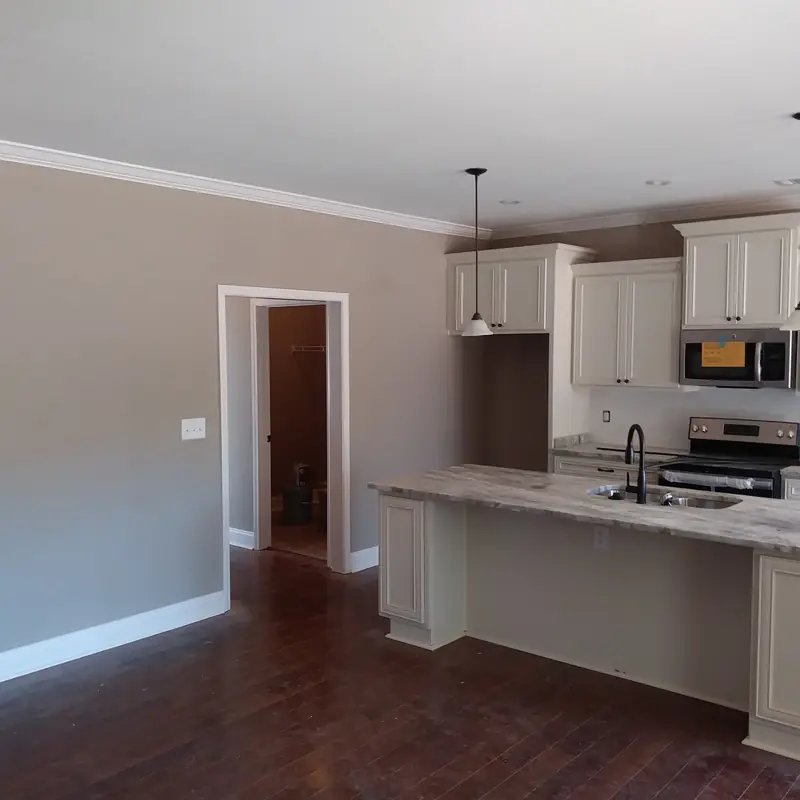
You patch a hole, paint over it, and a week later the patch is still there, a dull square in a wall that otherwise has a soft glow. New sheetrock does the same thing on a bigger scale. The paint goes on, the lights come on, and every taped seam shows up as a faint stripe. None of this is really the finish coat's fault. It happens because the surface underneath is part paper and part joint compound, and those two do not absorb paint the same way.
Why a patch shows up
Drywall has a paper face. Joint compound, the plaster-like material used to fill seams and holes, is far more porous. Roll finish paint straight over both and the compound drinks in more of the paint than the paper does. The patch ends up looking flatter and duller than the area around it, which painters call flashing. If the patch is smooth and the surrounding wall or ceiling has a texture, it gets worse, because the two catch the light differently.
What primer does on new and repaired drywall
A drywall primer seals the surface so that it absorbs evenly. It fills the pores in the paper and the compound, so the finish coat sits on top of the surface instead of sinking into it. That is why painters prime all new sheetrock and every patch, even when the rest of the wall is already painted. Skipping primer to save a step often means needing extra coats of finish to get an even look, and the result can still be blotchy.
For a patch that disappears, the order of work matters:
- Fill the hole or seam in thin layers rather than one thick one, and let each layer dry before the next.
- Sand it smooth and feather the edges well past the patch itself.
- Vacuum or wipe off all the dust, because paint over dust does not bond.
- Match any texture on the surrounding surface before priming.
- Prime the whole patch and a little beyond it.
- Paint the finish coat from corner to corner of the wall or ceiling, not just the repaired spot.
Why ceilings get their own finish
Ceilings are lit at a shallow angle, usually by daylight sliding across them from a window, and that raking light exaggerates every bump, roller mark and patch. A flat ceiling paint scatters light instead of bouncing it back, so it hides flaws that a satin finish would highlight. That is the main reason ceilings are usually done in flat while the walls get a little more sheen. Flat paint marks more easily when scrubbed, but nobody scrubs a ceiling.
Keeping a wet edge
Roll a ceiling in sections you can finish before the paint starts to set, and keep the leading edge wet. If one strip has dried by the time the next is rolled up against it, you get a visible lap line. Cut in the edges with a brush and roll right behind the brush, before the cut line dries, so there is no darker band along the border. Finishing with light, even strokes in a single direction takes out most of the roller texture.
New sheetrock adds one more job: the dust. Sanded joint compound leaves a fine white powder on everything, including the tops of door frames and the floor edges. It gets vacuumed and wiped before primer goes on, because primer applied over powder sits on the powder instead of the wall.
Water stains are a different problem
If a ceiling has a brown ring from an old leak, ordinary primer will not hold it back. The stain bleeds through the paint again and again. The leak has to be fixed first, the area allowed to dry fully, and then a stain-blocking primer goes on before the finish coats. If the sheetrock itself is soft or sagging, that section needs to be replaced rather than painted, since paint cannot hold up a damaged board.
It also helps to do the ceiling before the walls. Any drips or spatter from rolling overhead land on surfaces that are about to be painted anyway, and the walls then get cut in cleanly against a finished ceiling line.
A customer named timothy webb described Unique Painting's sheetrock work in a review as a "fabulous job on our ceiling." Ceilings are where a lack of prep shows most, so a comment like that usually means the unglamorous steps got done.
In Bonaire and Warner Robins, if you have a patched ceiling that still shows or fresh sheetrock waiting for paint, Earnest at Unique Painting can talk through what the surface needs at (478) 420-1979.
Unique Painting LLC, (478) 420-1979
Call (478) 420-1979More articles
Why Kitchen Cabinets Need a Different Paint Than Your Walls
A cabinet door lives a rougher life than any wall, and the paint and the process have to be chosen to match.
What Happens Before the Color Goes on a Lap Board House
A good exterior paint job is decided in the days before the first coat, and those days are mostly scraping, patching and waiting for wood to dry.