Chapter 01
What goes wrong with painted trim over the years?
Trim is the part of a room you see from arm's length, so it shows its faults sooner than a wall does. The first sign is usually the thin line where baseboard meets wall, where old caulk has dried, shrunk and split into a dark crack. Next come brush ridges frozen into thick enamel, runs that sagged at the bottom of a door casing, and a yellow tint creeping into white paint that has sat in a sunny room.
The second trouble is the wrong sheen. Flat wall paint on a baseboard scuffs the first time a vacuum bumps it, while a high gloss shows every dent and sanding scratch like a spotlight. Trim wants a harder finish than the walls, but a controlled one. Then there is the cut line, the edge where trim colour meets wall colour. Where it wobbles, a room with good paint still looks hurried.
The rooms Earnest has finished around Bonaire show the alternative plainly: white crown and baseboard against greige and khaki walls, with a line that stays straight from one corner to the next.
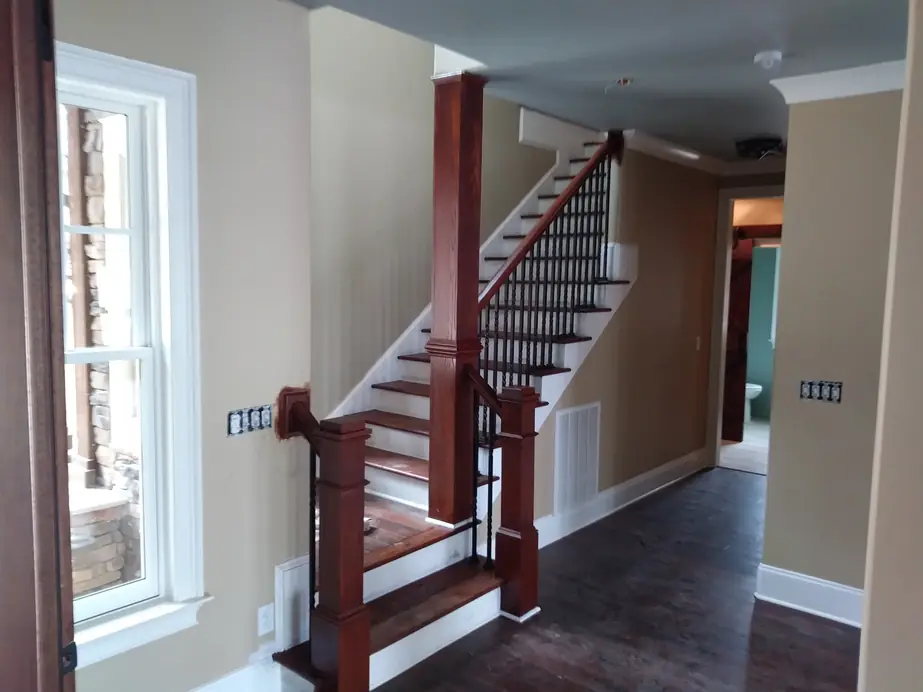
Stair hall with white painted risers, khaki walls and white baseboard
Caulk, prime, sand, cut: how trim gets painted
Nail holes are filled and sanded flush, and old glossy enamel gets a scuff sanding so new paint has something to grip. Dust comes off with a vacuum and a damp rag. Gaps between baseboard and wall, and between crown and ceiling, get a thin bead of paintable caulk, tooled smooth with a finger and wiped clean, so the seam closes instead of opening again next season.
Bare wood and filled spots get primer. Then the enamel goes on, brushed with the grain and laid off lightly, in semi-gloss or satin depending on the room and how much the owner wants the trim to show. Brushing is slower than spraying, but it lets the enamel level into a smooth skin and keeps paint off everything else in a lived-in house. A fine sanding between coats knocks off dust nibs and leaves the second coat glassy.
Cutting in comes last, and the order matters. If the walls are being painted too, the trim goes first and the wall colour is cut against the dry trim with an angled sash brush. Door casings and stair risers get the same treatment, one riser at a time, so every scuffed step ends with the same finish. The stair hall in our photos pairs white painted risers with stained treads, which means the line between them is masked and checked step by step.
Chapter 03
Looking after painted trim once it has cured
Enamel feels dry to the touch long before it is hard, and trim painted last week will mark more easily than trim painted last season.
Give it time before scrubbing, taping or leaning furniture against it, and ask at the walkthrough how long the product being used needs. After that, a soft cloth and warm water takes off most scuffs. Harsh cleaners and abrasive pads dull the sheen in patches, and a dull patch on a baseboard shows from across the room. A small labelled jar of the leftover trim paint covers a chip at a door edge in a minute.
The signs it needs doing again are easy to read: caulk lines opening at the top of the baseboard, yellowing against fresh walls, and chips along stair nosings and door edges where hands and shoes land. Catch those before bare wood shows and it stays a touch-up instead of a full repaint. Homeowners in Warner Robins and Bonaire can reach Earnest at (478) 420-1979.
“He was knowledgeable on his explanation on what was the best type of paint to use” Colette Nash, Google review.