Chapter 01
Why does stain go blotchy, rough or streaky?
Stain does not sit on top of wood the way paint does. It soaks in, and wood does not soak evenly. Pine and birch drink it in patches, leaving dark blotches beside pale ones. Wood fibres also stand up the moment moisture touches them, which is the raised grain that makes a freshly stained door feel like fine sandpaper.
Streaks come from how it is put on. Stain left to sit on one stretch of a door while the next stretch gets worked turns into a lap mark, a dark band where two wet edges overlapped. Handrails wear in their own way: hands polish the clear coat off the top of the rail first, leaving a dull path where the finish has gone and bare wood starts taking in skin oil and dirt.
Doors beside a sunny window fade, and a hall door that opens a thousand times collects fingerprints around the knob. Neither one is a defect. Both are the reasons the clear coat matters as much as the colour.
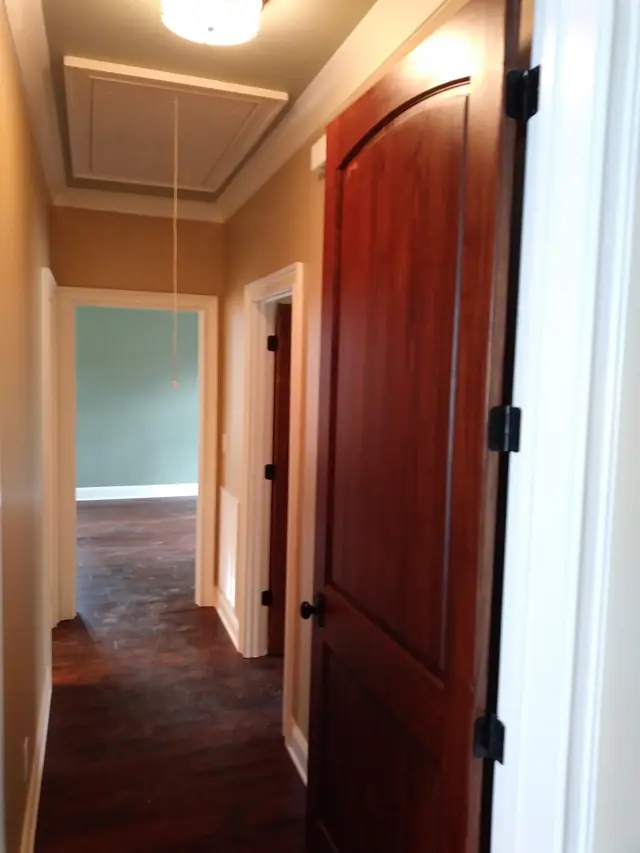
Stained wood interior door set in a khaki hallway with a sage room beyond
Sanding, conditioning, wiping on stain and clear coating
Sanding goes in steps from medium paper to fine, always with the grain, then a vacuum and a tack cloth. Old varnish is sanded back, or stripped where it is too thick, until stain can actually reach the wood. Painted walls, white risers and wrought-iron balusters beside a stair get taped and covered first, because stain on a white riser is not coming off.
Blotch-prone wood gets a pre-stain conditioner, which evens out how fast the fibres take colour. The stain is wiped on with a rag, worked along the grain one section at a time and wiped back off before it sets, so the colour is judged on a finished surface instead of a wet one. The first coat of clear finish is the one that raises the grain, and a light sanding with fine paper takes it back down before the last coats.
Clear coat goes on in thin brushed coats rather than one heavy one, with that light sanding between each. On a handrail or newel post the last pass runs the full length in one go, so there is no lap mark where a hand will land. A stair hall with stained cherry treads, rail and posts set against painted risers is a job where the masking is half the care.
Chapter 03
Keeping a stained door or stair rail looking right
A stained finish is only as good as its clear coat, and the clear coat is the part that gets worn, not the stain.
Wipe stained doors and rails with a soft damp cloth and dry them afterward. Skip wax, ammonia sprays and abrasive pads, which cloud clear finish, and go easy on furniture polish, which leaves a film that makes later recoating harder.
Watch the places hands land. When the top of a rail goes dull, or a door edge near the knob turns pale, the clear coat is going, and a light scuff sanding with a fresh coat is a small job. Wait until the colour itself is bare and it becomes a bigger one. Earnest looks at stair rails and doors around Warner Robins and Bonaire on a walkthrough and tells you plainly which one yours needs. The number to ring is (478) 420-1979.
Unique Painting — Locally owned in Bonaire, Georgia. Call (478) 420-1979.