Inside the house
Interior Painting
Walls, hallways, bathrooms and ceilings, with a cut line along the crown you can actually look at.
Chapter 01
Why does a freshly painted room still look tired?
Most rooms that look worn are not worn through, they are marked. A hallway collects the oils from a thousand hands on the same stretch of wall at shoulder height. A kitchen wall behind the range picks up a film of cooking grease that you cannot see until the new paint refuses to stick to it. A bathroom holds steam after every shower, and a flat wall paint in there starts to blister or speckle with mildew long before the colour itself has faded.
The second thing that fails is the paint job itself. A wall rolled in two different sheens shows a patchwork when the afternoon light rakes across it, and painters call that flashing. Roller laps show where a wet edge was allowed to dry before the next pass. A cut line along the crown that wanders by an eighth of an inch is invisible on the day and obvious every day after. Homeowners around Bonaire and Warner Robins tend to describe all of this the same way: it looks like somebody painted it in a hurry.
Dark and strong colours add their own trouble. A navy accent wall beside a gold one, like the pair in one of Earnest's living rooms, needs a tinted primer under it, or the first coat goes on streaky and the finish coats have to do work they were never meant to do.
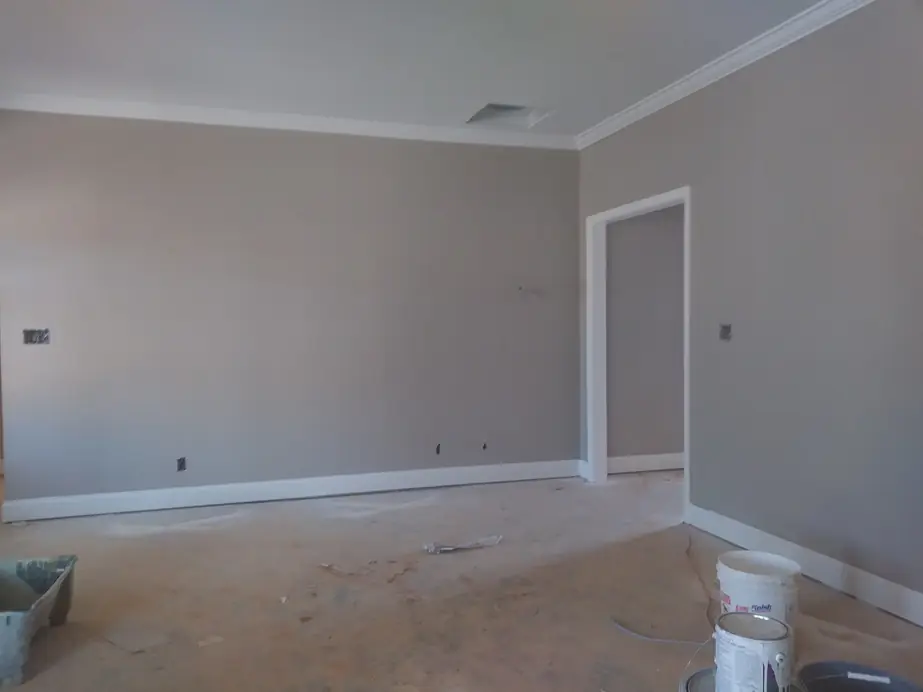
Greige living room walls with white crown moulding, roller tray and paint cans on the floor
Prep, primer and the cut line, in the order they happen
The floor goes down first, with drop cloths taped along the baseboard, and the switch plates and outlet covers come off rather than being painted around. Walls get a wipe with a degreasing cleaner where hands and kitchens have been at them, then a light scuff sanding so the new coat has something to bite. Nail holes and dents get filled with spackle, sanded flush, and spot primed, because spackle left bare drinks paint differently from the wall around it and shows as a dull dot.
Primer is chosen for the job in front of it. A tinted primer goes under deep colours, a stain-blocking primer goes over water marks and smoke, and a bathroom gets a mildew-resistant primer and a paint with a sheen that can be wiped. Then comes the cutting in: a good angled brush, a steady hand along the crown, the ceiling line and the trim, so the edges are done before the roller ever touches the field of the wall. The field is rolled in a W pattern and finished in one direction while the edge is still wet, which is how the laps disappear.
Sheen is picked room by room. A flat or matte on ceilings hides the small flaws overhead, which is the kind of work timothy webb praised on his sheetrock ceiling. Eggshell suits living rooms and bedrooms, satin suits hallways and kids' rooms that get scuffed, and semi-gloss belongs on the trim so it reads crisp against the walls. Colette Nash said Earnest was knowledgeable in explaining what type of paint suited which surface, and that conversation is where the sheen gets settled, before the first coat.
Chapter 03
Keeping the walls clean, and how you know it is time again
A coat of wall paint feels dry within hours but keeps hardening for weeks. In that stretch, go gently: keep furniture a hand's width off the wall, do not scrub, and hold off hanging heavy frames on fresh paint. When a mark does land on it, a soft sponge with mild soap and a light touch lifts most things without burnishing a shiny patch into a flat wall.
You can tell a room needs painting again by a few plain signs. Scuffs that no longer wash off, a yellow cast on white walls and ceilings, hairline cracks running from the corners of door frames, and bathroom paint that bubbles or peels near the shower are the usual ones. If a wall shows a shadow where a picture used to hang, the paint has aged unevenly and a patch will not match, so the whole wall is repainted corner to corner.
If you are in Bonaire or Warner Robins and want a room, a hallway or a whole house looked at, call Earnest on (478) 420-1979. He prices the work before he starts, which is what Jarvis Dotson wrote about him, and he leaves the furniture back where he found it.
“Did a fabulous job on our ceiling, painting sheetrock work.” timothy webb, Google review.