The kitchen
Kitchen Cabinet Painting
Doors, frames and boxes painted in a hard enamel, so the cabinets you already own look like a new kitchen.
Chapter 01
Why do kitchen cabinets wear out before the walls do?
A cabinet door gets opened and shut dozens of times a day, and the same few spots take every touch: the edge beside the pull, the rail above the stove, the frame around the sink. Those spots collect cooking grease and hand oil until the finish goes tacky and dull, then yellow, then starts to chip at the corners. The walls in the same room might be fine, which is why a tired kitchen often looks worse than the rest of the house.
Plenty of people assume the answer is a new set of cabinets. Often the boxes are solid and the doors are fine in shape, and the only thing that has failed is the surface. Repainting what you already have keeps the layout and the real wood, and that is the idea behind cabinets painted rather than replaced.
It is also where the wrong paint shows quickly. A wall paint rolled onto a cabinet stays soft for weeks, sticks where the door meets the frame, and scratches off with a fingernail. Colette Nash noticed that Earnest could explain the best type of paint for her walls and the best type for her kitchen cabinets, and they are not the same can.
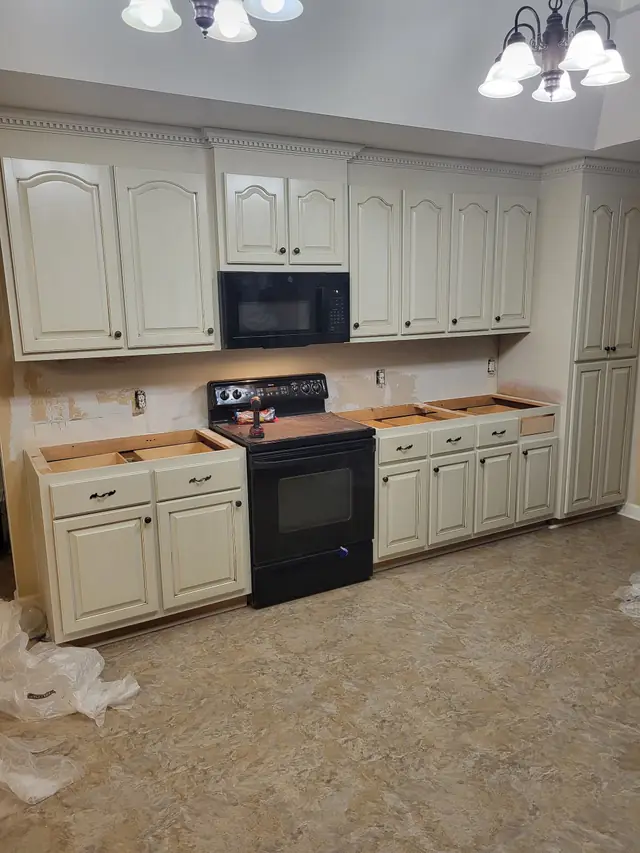
Kitchen cabinets refinished in antiqued cream with the countertops out mid job
Degreasing, scuff sanding and the enamel coats
The doors and drawer fronts come off, each one numbered on the back with a pencil so it goes home to the same hinge, and the hardware is bagged. Everything gets a hard degrease first. Paint will not bond to kitchen grease, however good it is, so the cleaner goes on twice and the surface is rinsed and left to dry before sandpaper comes anywhere near it.
A scuff sanding follows, just enough to dull the old finish and give the primer teeth, with the edges and any raised grain taken down by hand. Dust is wiped off with a tack cloth. Then a bonding primer goes on the doors, the frames and the boxes, followed by two thin coats of a hard cabinet enamel, with a light sanding between coats. Thin coats matter more than thick ones, because a heavy coat sags into runs and takes far longer to cure. A fine foam roller lays the flat panels and a brush works the profiles and corners.
The antiqued cream doors in the photo above were hung back mid-job with the countertops out of the kitchen, which is the stage where a finish can be judged under real light. An antiqued look is built from a glaze wiped back into the recesses of the door so the cream deepens at the edges, and it is the kind of detail that needs the doors laid flat and the glaze handled while it is still workable. Colette's job was finished ahead of the time frame Earnest agreed with her.
Chapter 03
Living with painted cabinets, and when they need another coat
Enamel feels dry to the touch well before it is hard. For the first weeks, open and close the doors gently, keep stuck-on bumpers off the fresh paint, and do not scrub. Wipe spills with a damp cloth and a drop of mild soap; harsh sprays dull a cabinet finish and lift the edges.
Watch the places that took the abuse in the first place. Edges beside the pulls, the door under the sink, and the frame near the stove will tell you first. A chip is easy to touch up with a small brush and a dab of the same enamel if you catch it early, while a door that has begun to stick to its frame or feels tacky near the range is asking for a proper recoat.
If your kitchen in Bonaire or Warner Robins is worn at the edges and the boxes are still sound, Earnest at (478) 420-1979 will look at the doors with you. He quotes the price before starting, and he can tell you whether painting is enough or whether a few doors are past saving.
“He was knowledgeable on his explanation on what was the best type of paint to use for the walls and kitchen cabinets.” Colette Nash, Google review.